
Address:92 Xidazhi Street, Nangang District, Harbin
Zipcode:150001
Tel: 0451-86413408
Email:qqzhang@hit.edu.cn
|
 104
104
|
Recently, Professor Qi Jiarran’s team from the School of Electronics and Information Engineering, Harbin Institute of Technology (HIT), has made new progress in the field of microwave wireless power transfer (WPT), developing a compact wireless power transfer framework. The relevant results were published in Nature Communications under the title Intelligent Wireless Power Transfer via a 2-bit Compact Reconfigurable Transmissive-Metasurface-Based Router. Benefiting from advantages such as low cost and compactness, this framework is expected to promote the application of metasurface-based wireless power transfer devices in smart homes, implantable medical devices, industrial robots, transportation, on-orbit aerospace and other fields. The team demonstrated charging of multiple daily devices such as LED lights, mobile phones and power banks using this wireless energy transmitter, and also conducted simultaneous wireless information and power transfer (SWIPT) demonstrations with the transmitter, fully demonstrating the application potential of this wireless power transfer framework.
The team proposed a compact wireless power transfer framework based on a reconfigurable transmissive metasurface. The core components of the framework include a plane wave feed and a 2-bit phase-reconfigurable transmissive metasurface, which together form a multi-beam reconfigurable wireless energy transmitter. The transmitter has a sub-wavelength (0.8 times the operating wavelength) profile, and its overall size is equivalent to that of a 27-inch liquid crystal display (LCD). Combined with a deep learning-driven environmental sensor, this wireless energy transmitter can detect and locate multiple moving devices, and simultaneously transmit wireless energy and information to these devices. The plane wave feed can generate a uniform wavefront approximating a plane wave in the near-field region, thereby exciting the metasurface, reducing the system profile to a sub-wavelength scale, which is an order of magnitude lower than the sub-wavelength scale of current mainstream excitation schemes. The 2-bit reconfigurable transmissive metasurface consists of 169 structural units, and achieves precise control of the wavefront phase through a spatiotemporal programmable modulation scheme. The combination of the near-field plane wave feed and the reconfigurable transmissive metasurface forms a wireless energy transmitter, which can wirelessly transmit energy to multiple targets (such as smartphones and unmanned aerial vehicles (UAVs)). In addition, the framework also includes an environmental sensor and an intelligent computing unit. The environmental sensor is used to collect dynamic information such as the number and position of targets to be charged. The intelligent computing unit processes the information from the sensor to generate specific phase patterns for controlling the wireless energy transmitter. Without human intervention, the transmitter can realize wireless energy and information transmission to multiple moving targets in a random environment.
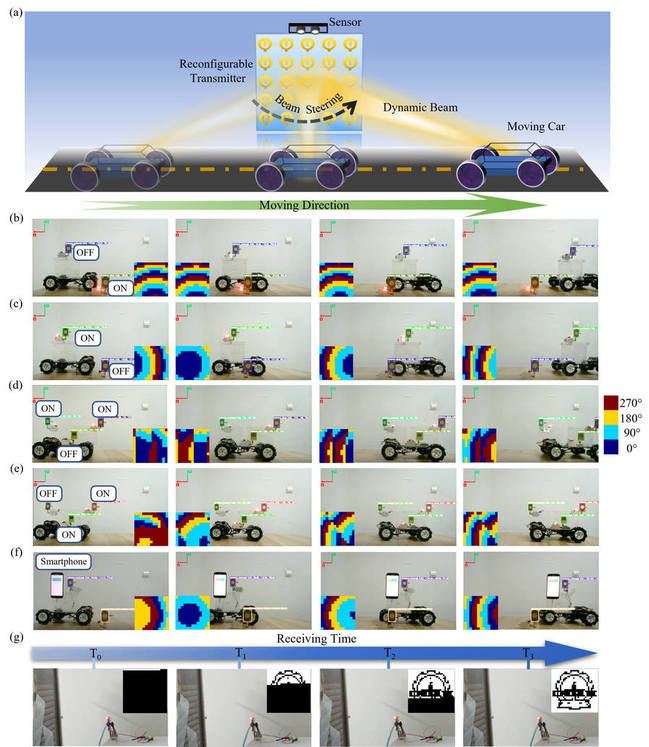
Experiment of wireless power transfer and simultaneous wireless information and power transfer (SWIPT)
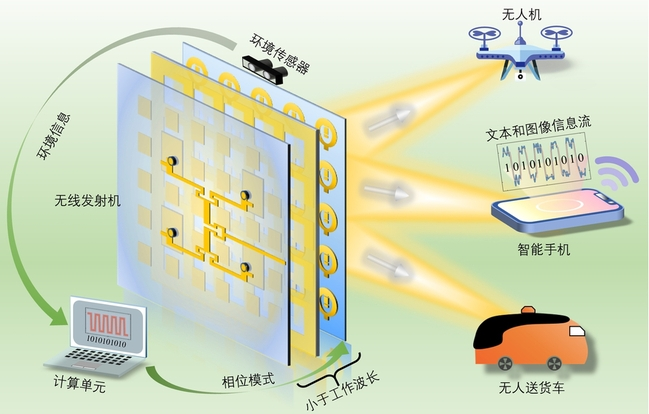
Figure 2. Schematic diagram of the compact wireless power transfer framework and its application scenarios